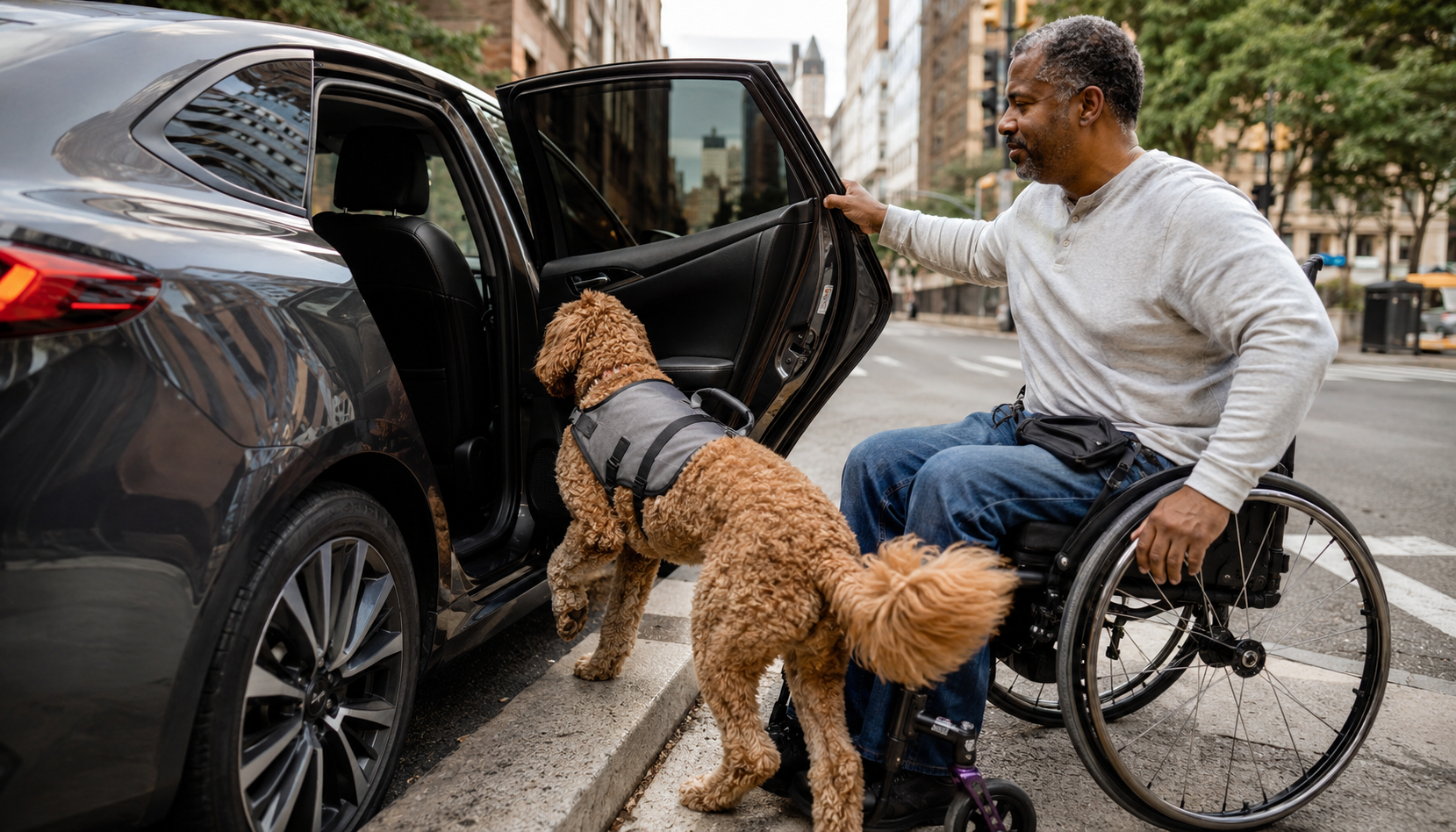
Your ADA Rights in Restaurants, Airlines, and Rideshare (2026 Edition)
Three of the most common friction points for handlers. The ADA covers them differently — and rideshare drivers have started canceling at higher rates than ever. Here's the law and the scripts that actually work.
Restaurants
Any restaurant open to the public is covered by the ADA. They cannot:
- Refuse entry because of the dog
- Require you to sit on the patio when other diners are inside
- Charge a pet fee
- Demand documentation
They can ask the two ADA questions, and they can ask you to leave if your dog is out of control or not housebroken (rare and obvious, barking continuously, jumping on tables).
The script that works
"Hi, table for two. My service dog [Name] is trained to [task], she'll lie under the table."
Mentioning the task proactively and previewing your dog's behavior usually skips the awkward "are you sure that's a service dog" exchange entirely.
Airlines
This is one of the most-confused areas in the field because the rules changed in 2021 and a lot of old info is still floating around online.
Current rules (as of 2026):
- Service dogs: Free cabin access, no pet fee, no carrier required. You may need to fill out a DOT form 48 hours before departure attesting to training, behavior, and (for flights 8+ hours) relief plans.
- Emotional support animals: No longer recognized by federal aviation rules. Airlines treat ESAs as regular pets, pet fees apply, carrier required, breed restrictions may apply.
The DOT form
For service dogs, most US airlines require the DOT Service Animal Air Transportation Form 48 hours before your flight. You submit it once per trip. It asks:
- Your dog's training
- Your contact info
- That your dog has been vaccinated and behaves in public
- A relief plan for long flights
Forms are available on each airline's website. Submit early. Last-minute submissions cause boarding-gate friction.
Rideshare (Uber, Lyft)
Rideshare is where the most disputes happen in 2026. Both Uber and Lyft have firm policies: drivers cannot refuse service dogs. A refusal is a violation of both company policy and the ADA (since Uber and Lyft are public accommodations).
What to do when a driver cancels
- Take a photo of the cancellation screen with timestamp visible.
- Report immediately via the app: "Driver refused service dog." Don't wait, report the same trip.
- Email policy escalation: Uber: ada@uber.com / Lyft: accessibility@lyft.com. Include trip ID, date, driver name.
- Re-book. Most drivers will not cancel, especially after the first one was reported.
- If pattern repeats, file with DOJ: Repeat offenders create civil rights complaint patterns. Both Uber and Lyft have been sued (and settled) over driver refusals.
If they refuse and threaten consequences
You have multiple recourse options:
- Civil ADA complaint: ada.gov/file-a-complaint (free, takes 6-12 months)
- State attorney general: Many states pursue ADA cases at state level
- Small claims court: Damages typically $1,000-$5,000 for first offense, often higher for repeat businesses
- Disability rights law firm: Many work on contingency for clear-cut cases
Most cases settle before reaching a courtroom. Businesses know they'll lose, and the legal bills add up fast.
Written and reviewed by the ADA Service Dog Team
VerifiedADA Service Dog is operated by NS Design ID Cards, the team behind assistancedogregistry.co.uk and esasupport.co.uk, supporting assistance dog handlers since 2020 with over 20,000 ID cards shipped. Our guidance is grounded in the Americans with Disabilities Act and current Department of Justice, DOT, and HUD guidance. Registration is voluntary, and we always say so honestly.
Important
This article is general orientation, not legal advice. For your specific situation, contact the ADA Information Line at 1-800-514-0301 or a disability rights attorney. ADA Service Dog Registry is a voluntary handler identification platform, not affiliated with the ADA, DOJ, or any US government agency.
Keep reading
Do Service Dogs Have to Be Registered? No. Here's What That Means for You
There is no federal service dog registry, no state requires one for ADA access, and no business can demand pap...
Read →
What Can a Landlord Legally Ask About Your Service Dog? (2026 HUD Update)
HUD withdrew its long-standing assistance animal guidance in September 2025, and a May 2026 enforcement memo n...
Read →
Service Dogs and Renting: Pet Fees, Breed Bans, and No-Pet Buildings (2026 FHA Guide)
No pet deposit, no pet rent, no breed restrictions: under the Fair Housing Act a service dog is not a pet. A p...
Read →Get the card. Skip the explanations.
Digital handler ID + AI ADA Coach + state-specific rules from $4.99/mo. 30-day money-back guarantee on lifetime plans.
See plans →