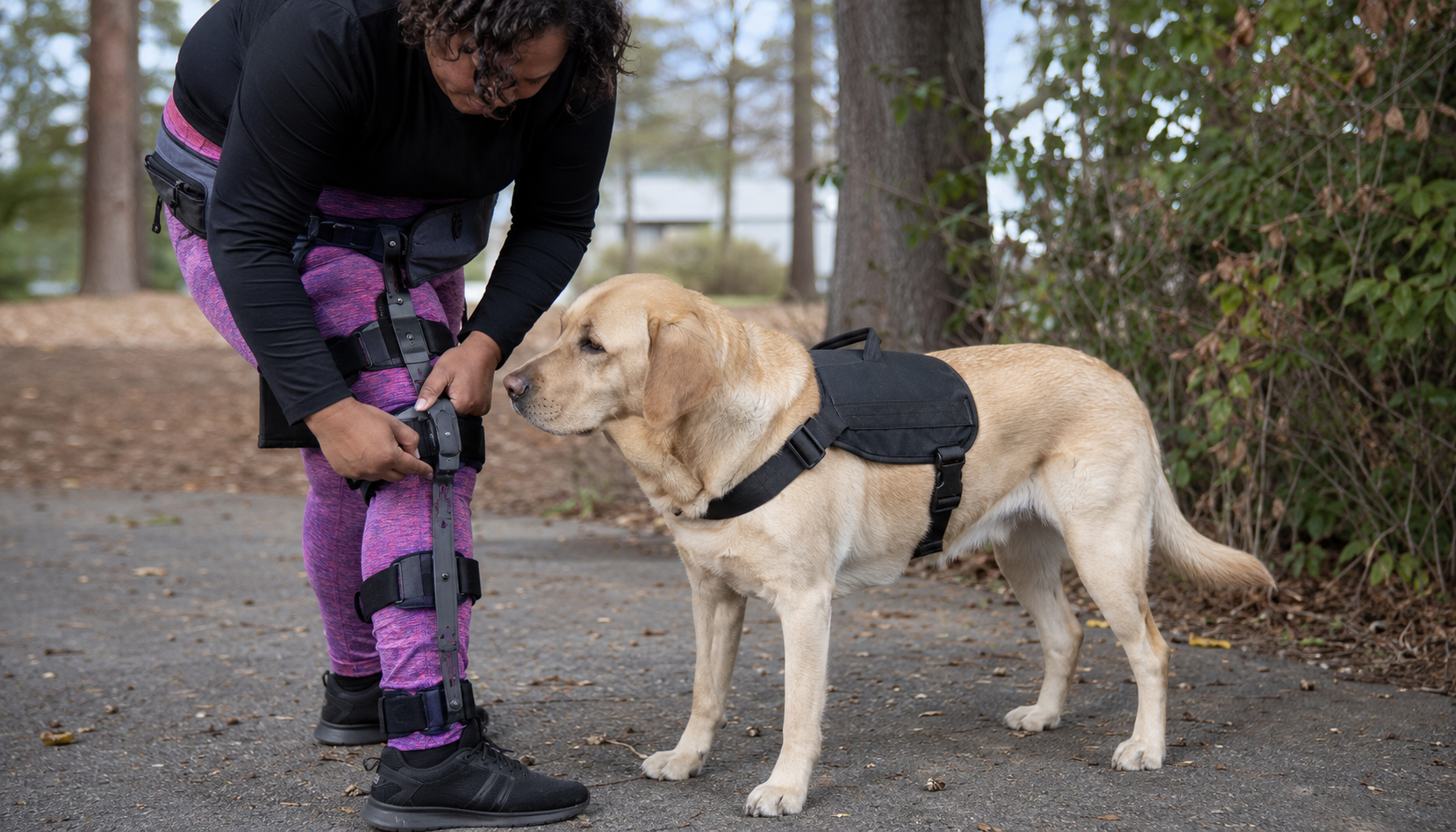
Training My Own Service Dog: 18 Months of Mobility Tasks
The ADA explicitly allows owner-trained service dogs. One handler walks through the entire 18-month journey — from rescue puppy to a dog who retrieves dropped medication, opens doors, and braces against falls.
Why owner-train?
James's hip dysplasia means he falls. Not often, but unpredictably. Two falls in 2024 ended in ER visits. A friend suggested a service dog. James investigated programs.
The reality: service dog programs have 2-5 year waitlists and cost $20,000-$50,000. Most veterans get program-trained dogs via charities (K9s for Warriors, Patriot Paws, etc.) but James isn't a veteran. He works full-time. The waitlist alternative was untenable.
So James did what the ADA explicitly allows: he trained his own.
Picking the dog
This is where most owner-trainers fail. The candidate dog has to have:
- Stable, calm temperament in unfamiliar environments
- No reactivity to people or other dogs
- Health, hips, eyes, joints clear for a long working life
- Size match for the task (a 25-lb dog can't brace a 200-lb handler)
- Eagerness to work, a dog that lives to please, not a fiercely independent one
James adopted Rocky, a 1-year-old Labrador, from a rescue. Rocky had been returned twice as "too much dog" for casual pet families. James saw a dog who needed a job.
Month 1-3: Foundation obedience
Before task training, the dog has to be reliable on basic obedience in any environment. Six days a week, 20 minutes a day, in increasingly challenging locations:
- Living room → backyard → quiet park → busy park → coffee shop → grocery store
- Sit, down, stay, recall, heel, leave-it, watch-me
- Public access manners: no sniffing food, no greeting strangers, no marking
James used a private trainer for the first 4 weeks ($75/session, twice a week). After that, monthly check-ins.
Month 4-9: Task introduction
The four specific tasks James targeted:
- Retrieve dropped medication. Started with pill-shaped object on the floor at home. Built to retrieving any object. Took 3 months.
- Open accessible doors. Push-plate accessible doors. Rocky learned to nose the plate and back away. 6 weeks.
- Brace against falls. The most dangerous to train wrong, bracing requires Rocky to be physically positioned correctly or he could injure his own back. James worked with a professional who specialized in mobility tasks.
- Retrieve cane. Trained to fetch James's cane on verbal cue. 8 weeks.
Month 10-15: Public access proofing
This is the hardest part of owner-training. The dog needs to perform tasks reliably in any environment. Every grocery store. Every restaurant. Every doctor's office.
James kept a log. Each public outing was rated 1-5 on Rocky's performance. By month 15, Rocky was averaging 4.5+ across every environment.
Month 16-18: Final certification (for owner-trainer documentation)
The ADA does NOT require certification, but James created his own documentation for his own records:
- A training log (date, location, task, performance)
- Video of each task being performed reliably
- Veterinary records confirming Rocky's health
- A statement from his trainer attesting to the work
This isn't legally required. But James found it useful when filing housing accommodation requests, landlords sometimes ask for "training records" (which they have no right to demand under ADA, but providing them avoids escalation).
What it cost (the honest numbers)
- Adoption fee: $400
- Initial trainer (4 weeks intensive): $1,200
- Monthly check-ins (14 months): $1,050
- Treats, training gear, equipment: ~$600
- Veterinary preventive care: ~$1,000/year x 2 = $2,000
- Total: ~$5,250
Versus a program-trained dog at $20-50k. Even with the time investment, the cost difference is significant.
What James wishes more would-be owner-trainers knew
- This is hard. 18 months of consistent daily work. Most people quit at month 4.
- Most rescue dogs aren't candidates. Don't try to train a fearful, reactive, or high-drive dog. Pick a candidate carefully.
- Get a real trainer. "Watching YouTube and winging it" works for basic obedience. It does not work for service dog tasks.
- Find an owner-trainer community. Service Dog Central forum, autism-specific service dog Discord, the IAADP (International Association of Assistance Dog Partners). Owner-trainers help each other.
- Don't fake it. If your dog washes out (some do, temperament reveals itself), accept the loss, find a different solution. Don't try to pass an undertrained dog as a service dog.
Written and reviewed by the ADA Service Dog Team
VerifiedADA Service Dog is operated by NS Design ID Cards, the team behind assistancedogregistry.co.uk and esasupport.co.uk, supporting assistance dog handlers since 2020 with over 20,000 ID cards shipped. Our guidance is grounded in the Americans with Disabilities Act and current Department of Justice, DOT, and HUD guidance. Registration is voluntary, and we always say so honestly.
Important
This article is general orientation, not legal advice. For your specific situation, contact the ADA Information Line at 1-800-514-0301 or a disability rights attorney. ADA Service Dog Registry is a voluntary handler identification platform, not affiliated with the ADA, DOJ, or any US government agency.
Keep reading
How I Stopped Hiding My Disability at Work With My Service Dog
Reasonable accommodation and bringing a service dog into a workplace.
Read →
From Walmart Interrogations to Walking Free: A PTSD Veteran's Story
Marcus served two tours. His service dog Buddy can interrupt panic episodes in 4 seconds flat. But the hardest...
Read →
Autistic Adults & Service Dogs: Why an ID Card Changed Everything
An autistic handler's story about meltdown interruption, deep pressure therapy, and what it's like to navigate...
Read →Get the card. Skip the explanations.
Digital handler ID + AI ADA Coach + state-specific rules from $4.99/mo. 30-day money-back guarantee on lifetime plans.
See plans →